
‘A Breath of Fresh Air!’, St Nicholas Church, Chiswick, Thursday 18th June 2026
Presented by The Friends of St Nicholas’ Church and Hogarth’s House

Youtube playlist linked to this event: LINK
Francesco Barsanti – ‘Pinkie House’ (A Collection of Old Scots Tunes) (1742)
Jean-Jacques Rousseau/Pindar – Morceau de Musique Ancienne (1769) &
Malene Sheppard Skærved – Hymn to Apollo (A Breath of Fresh Air) (2026)
Giuseppe Torelli – B minor Concertino per Camera Op 4 No 7 (1688)
Largo – Allemanda- Gigha
Mihailo Trandafilovski – Chaconne (2022)
Nicola Matteis – Ayres for the Violin (1685)
Sarabanda Amorosa – Scaramuccia – l’Amore
George Fredrick Handel – 7th Suite (1720)
Ouverture – Andante – Allegro – Sarabande – Gigue – Passacaglia
Johann Christoph Pepusch – D major Sonata Op 2 No 9 (1706)
Adagio – Allegro – Adagio – Allegro
George Philipp Telemann – ‘Gulliver’s Travels’ (Der getreue Music-Meister) (1729)
Intrada – Lilliputian Ciaconna – Brobdingnagian Gigue –
Reverie of Laputans & their Waker-uppers – Loure of Noble Houyhnhnms/Furie of savage Yahoos
Giuseppe Tartini – G minor Sonata ‘Didone Abandonata’ (1731)
Affetuoso – Presto – Allegro
Malene Sheppard Skærved – Noise, Pollution (A Breath of Fresh Air) (2026)
David Hackbridge Johnson –Fantasia on the Apollo Belvedere (2025)
World Premiere
Largo – Sarabande with Divisions – Largo senza misura
Welcome to the first of three musical events celebrating the extraordinary ideas and art that were coursing around Chiswick in the age of William Hogarth and the Burlingtons. In October, we will be at Hogarth’s house, reflecting on William and his household, hard by the London Road, and in November at Chiswick House, playing music dedicated to the Boyles, Dorothy, and Richard, in their space.
Today, in this lovely church by the river, we are thinking about what escape from the clamour and smoke of the city meant for thinkers and artists lucky enough to spend time here in the 1700s, whether
visitors or residents.
Unsurprisingly, there is an undertone of the bucolic, in the music that we have chosen: this was a given in the instrumental music Lord Burlington would have loved, from works by Torelli which he would have heard on his first trip to Italy, to Pepusch, better known for his work on The Beggars Opera. Instrumental suites and sonatas always wended their ways to the fields, to the pastoral.
Longing for the countryside in this age, was far from the actuality that would be celebrated by the end of the century. For the generation of Pope, this required the assistance of the classical imagination – the eclogues of Virgil, the presence of the Olympians. The Burlingtons’ Palladian pavilion next door, is all set about with Theban Sphinxes, and peopled with the immortals; and it stands in the garden they built with William Kent representing the Greco-Roman ideal: on one side of the water, Apollo’s idealised world in and around the house, on one side, and the savagely Dionysian, the world of Pan, the dark wood, on the other.
Just so Tartini’s own ‘Breath of Fresh’, his sonata, takes us to the Aeneid, to the tragedy of Dido, abandoned in Carthage, alone with her sister Anna, with the memory of the Royal Hunt and Storm. This classical landscape is a place of regret, of idealised despair, the melancholy of the classically educated.
In contrast, William Hogarth’s non-classical education gifted him a famously playful imagination. He found common ground with the mind of Jonathan Swift, who regretted they never collaborated. Swift noted in 1736: ‘Thou, I hear, a pleasant rogue art. /Were but you and I acquainted, /Every monster should be painted’. Telemann’s suite after Swift ends with a very particular view of the countryside, pitting the high-minded Houyhnhnms against the Yahoos, dashing around in the dirt. A pastoral indeed, but with humans throwing dung!
Everybody walked. It is a three hour walk here from Wapping, where Malene and I live, and a dead straight line to here, from Burlington’s house on Piccadilly, or Hogarth’s Leicester Square (then called Leicester Fields) Music is full of walking: Chaconnes, or passacaglias, are quite literally, ‘walks in the street’, but music. This is the case, whether its Handel doing it on the Harpsichord (he stayed with Burlington twice), or local composer/violinist Mihailo Trandafilovski, whose trek here is less arduous than ours!
David Hackbridge Johnson memorialises the cast of the ‘Apollo Belvedere,’ which young Lord Burlington brought back from Italy and stood under the cupola of Chiswick House (it is now in the John Soane Museum). A Matteis-like sarabande is varied, set up, if you like, in countryside, full of Vivaldi-esque birds and babbling brooks, and with a literal chasm near the end. Is it a cave behind a fountain, or the entry to the underworld? The conversations between worlds – between our time and the 18th century, and with the ancient imagination, are ongoing, very real, and powerful.’ Peter Sheppard Skaerved
The artists would like to thank everyone who have enabled this project to happen today, especially Kate Kulka, Simon Morgan, June Ford-Crush, and Hounslow Council. Thanks also to Research England & Royal Academy of Music for their support.
Giuseppe Tartini – G minor Sonata ‘Didone Abandonata’
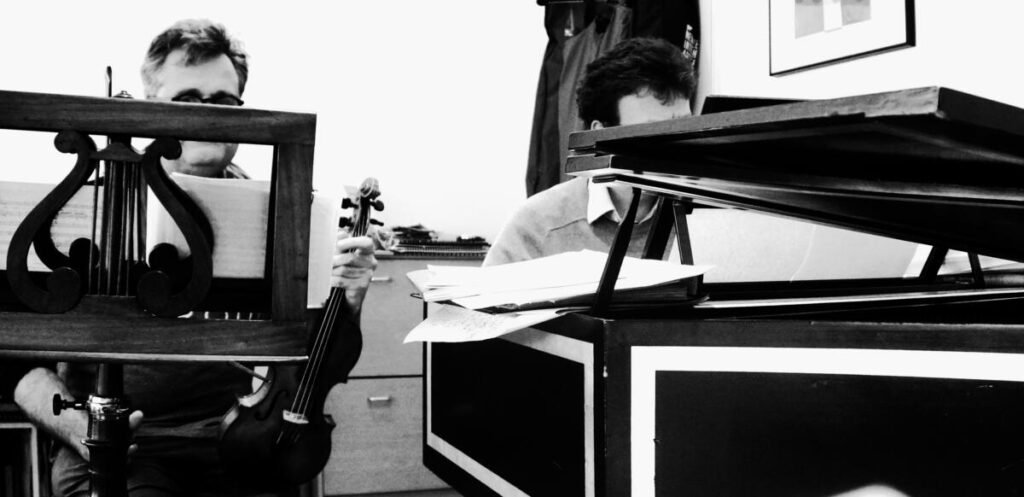
I play 33 Tartini sonatas, but this, the ‘Didone Abandonata’, was my first -one of the first pieces I studied with Ralph Holmes,when I was 12. It fills mewith ever more wonder, and playing it with my baroque co-conspirator, Julian Perkins is a joy. Here, just a rough camera recording of our rehearsal on Thursday
Performers:
Julian Perkins: Dubbed ‘‘The Indiana Jones of Early Music’’ by BBC Radio 3, Julian Perkins is Artistic
Director of Portland Baroque Orchestra in Oregon, USA, and Founding Artistic Director of
Cambridge Handel Opera and Sounds Baroque in the UK.
Julian has performed regularly at the Salzburg Festival, directed numerous ensembles
ranging from the Academy of Ancient Music to the Charlotte Symphony Orchestra, and
appeared as a soloist with ensembles such as the Bayerisches Staatsorchester, Florilegium,
and Orchestra of the Age of Enlightenment. Shortlisted for a Gramophone Award in 2021,
his distinguished discography includes world-première recordings of over thirty works by
composers ranging from Daniel Purcell to Héloïse Werner. His recent solo disc, Handel’s
Attick, holds the distinction of being the only clavichord recording ever selected as
‘‘Instrumental Choice’’ by BBC Music Magazine.
Passionate about education, Julian has given masterclasses at institutions such as The
Juilliard School in New York, Venice Conservatory and Royal College of Music in London,
and led Baroque and Classical projects for the Oregon Bach Festival, London’s Sinfonia
Smith Square and National Opera Studio. Of dual British-Italian citizenship, Julian studied at the University of Cambridge, Royal Academy of Music and Schola Cantorum Basiliensis

Malene Sheppard Skærved is a Danish-born writer and filmmaker. She moved to the USA in
her teens, before coming to London in the late 1990s. Her work hinges on the relationship
between travelling writers and performers, and their sense of place. This fascination informs
her critically acclaimed biography of Marlene Dietrich and work on Hans Christian Anderson.
Malene’s creation of a particular personal mythology is deeply rooted in people’s use of
storytelling to facilitate travel, crafts, religion and the day-to-day. Recent film work has
included a documentary of the painter, Joanna Jones and Music, Landscape and Meditation
collaborating with the conservationist Laurence Rose, commissioned for RSPB Farnham
Heath. She collaborates extensively with composers; Sadie Harrison has set several of her
poems, most recently A House of Countless Rooms was performed at Tremenheere Sculpture
Gardens by the Kreutzer Quartet. Three large scale musical monodramas working with Nigel
Clarke have been performed across the USA and Europe, and can be heard on Toccata
Classics. She teaches at Goldsmiths, University of London, where she is Lecturer and
Convener for Creative Writing.

Peter Sheppard Skærved is acclaimed internationally for performances of a vast range of solo repertoire. His repertoire stretches from the late 16th century to hundreds of works written for him: these include major works by composers by established ‘greats’ such as Hans Werner Henze and George Rochberg, to the many young composers with whom he collaborates worldwide. Peter is a Grammy-nominated recording artist, with over one hundred critically acclaimed albums to his name. These range from concerto discs with orchestras including the Vienna Radio Symphony Orchestra to the complete Tartini Solo Sonatas, 24 Telemann Fantasies, cycles of Beethoven, Mozart, and Schubert Sonatas, eight discs of solo works from the 1600s and many recordings of the works dedicated to him. Peter is currently performing, filming, and recording on great instruments in the collections of the Library of Congress, Washington DC, the Ashmolean Museum, Oxford, the Metropolitan Museum, New York City, and the Paganini violins kept at the City of Genoa .Peter’s wide ranging ‘Knowledge Exchange Violin’ Project brings together institutions ranging from the National Gallery of Art Washington DC through to the Royal Society for the Protection of Birds in the UK, with a linked series of concerts, recordings, residencies, films, recordings, podcasts and much more.

Macedonian-born, London-based composer, violinist and educator Mihailo Trandafilovski’s latest CD for Métier was released in 2022, and followed albums on Neuma (2021), Métier (2018), Innova (2015), Clarinet Classics (2013) and Lorelt (2011), featuring close collaborators Peter Sheppard Skærved, Neil Heyde, Roger Heaton, Roderick Chadwick, Linda Merrick, Saki Kato, Hugh Millington, Odaline de la Martinez, Lontano, Kreutzer Quartet and the New London Chamber Choir. These enduring creative relationships have been at the centre of his work as a composer and have allowed him to explore and stretch instrumental techniques in idiomatic and often uncompromising ways. His music has been performed by leading contemporary music groups such as Quatuor Diotima (France), Reconsil Ensemble (Austria), Ensemble Horizonte (Germany), Icarus Ensemble (Italy), Ensemble Fractales (Belgium), Meitar Ensemble (Israel), Moscow Contemporary Music Ensemble (Russia), The Cory Band (Wales), the European Contemporary Composers Orchestra; and has been broadcast throughout Europe, America and Asia. As a violinist, Mihailo has recorded and performed extensively, both as a member of the Kreutzer Quartet and in solo/duo settings; most recently, he released his solo album Step(pe)s (violin/computer) in 2021. He has an avid interest in the application of new music to pedagogy, and has led a number of shared projects among the arts promoting contemporary artistic creativity to a wider audience. Mihailo’s music is published by United Music Publishing.
