

August is my quiet time, and for me, quiet involves conversation. The conversations include the talks with friends as we travel across the Midwest of the USA, and now, from Connecticut to Washington ( I am writing this from a roof terrace overlooking New York’s Upper West Side in the early morning light). And, in a strange way, the talks with the figures from the past, music and more, seem to become more vivid, more in relief, during this annual wandering.
I will try and gather some of the ideas here. This is mainly for myself. After 11 days on the road, it is time to bundle up some of my thoughts, and make sense of them, or rather to see if there is any sense to be made. So I will begin with just what comes to mind as I sit here with my coffee.
…and it’s 4th fingers….
I am working on the set of Op 1 Sonatas by the violinist/composer Pietro Castrucci (1679 –1752), pupil of Corelli. He was brought to London by the young Lord Burlington, who met him on the Grand Tour. His book of Sonatas Op 1 was dedicated to Burlington. From my selfish point of view, it forms part of the work that Malene and I (in collaboration with Ben Hebbert) are doing around Chiswick House (which Burlington built) and nearby Hogarth’s House (the artist famously depicted Castrucci as the ‘enrag’d musician’).
But for the nones, I am just looking at the technical minutiae of the writing, violin in hand. As so ofter is the case, this helps in arriving at an understanding, even a concordat, with the physical preferences of the composer. It can also be revelatory. From an actor’s point of view, it’s a useful step in building a character.
Two nights ago, was an astonishing evening in Connecticut, where we were staying on Cote Pond, near Norwich, with our dear friends, Heather and Nic. And I spent some of the night, as the Northern Lights sailed over their house by the lake, working on the particularly melancholy E minor Sonata Op 1 No 2. This is a particularly sensitive key – Mozart only wrote one piece using it as home key (the K304 Piano/Violin Sonata)- and Brahms responded to it’s curious affect with
his Symphony No 4.
Perhaps the most contentious subject in violin-playing taste and aesthetics is/are open strings. In honesty, much of the heat around the debate has its origin in the notion of beginning: when we first pick up the instrument, we don’t immediately use the left hand to do more than hold the instrument up, and the strings are struck, ring, ‘open’. The crucial point here, is that when the strings are played without being fingered, they ring free: when we damp using the fingers of the left hand, the squishy nature of the stopping finger shortens and dulls the vibrating string, resulting in a ‘covered’ sound as a opposed to an ‘open’ one. For many people, this has a lifelong connection to the child’s violin, and is eschewed, except when the music evokes the ‘folk’ or ‘open-air’.
But the ‘beginning’ affect has another fundamental aspect, which is that then earliest instruments and the music played on

them relies on this ‘open’ effect. In our understanding of Apollo’s lyre, his cithera , the instruments was strummed with open strings, tuned to specific modes according to the mood of the poetry it accompanied. And the precursor of the violin family, the Lira da Braccia (which Apollo and Oprheuscame to hold in the Renaissance), relies on a plethora of unfingered, ringing strings, for its effect.
So open strings are the reminder of childhood, of the rustic, the folk, and of the mythical Ursprung/Quelle of the our instrument. Perhaps they are also the sound of the Universe, of the ‘Aum’.
Back to Castrucci: naturally, if you are writing in E minor, as here, the question of one particular open string will be salient – the ‘E’, the top string of the violin, sometimes referred to as ‘la chanterelle’, ‘la cantina’: the little singer. In the twentieth century, the use of a wire string for this became dominant. This was not new; in his ‘ Art of Playing on the Violin Op. 9,’, Castrucci’s compatriot and London colleague Francesco Geminiani (1687-1762) asked:
‘[…]is it possible to give meaning ton wood and wire, or to bestow upon them the Power of rasing and soothing the Passions of rational beings?’ Art of Playing on the Violin Op. 9 P.8
…which makes it pretty clear that he was using at least one ‘wire’ string (likely the E, with all of its attendant brightness). The expectation of a sombre melancholy attendant to E minor makes the use of this string (Gut or Wire), is a loaded one. And it’s worth noting that at the beginning of the 1700s it was relatively rare to encounter fingerings in published violin music (even thought performers were beginning to write them into their performing materials).
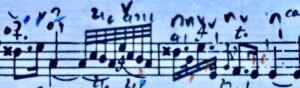
I was excited, working through this exquisite Sonata, to realise that Castrucci carefully annotates the use of the 4th finger, printed, nine times, on all the strings of the violin. But the indication affects more than nine notes – when the ‘4’ appears at the opening of a sequence/repetition of the same notes, then that affects as many notes as the finger covers therein, AND more importantly, Castrucci makes careful use of the ‘Unison’ (playing an open string with the same note fingered adjacent). Bach and Mozart loved to do this with the ‘D’ String. This gesture, in Castrucci’s sonata, demands the use of ‘4’.
However, what is most interesting, once we have considered all of the explicit use of the 4th finger to cover or replace the open string, as that, particularly in a relatively short work such as this sonata, the composer is giving use clear guidance as to when to let the strings ring open. Here is an analogy – we are careful to leave certain doors shut (front doors of homes, car doors, toilet cubicle/stall doors). The others can be left open -an instruction for a certain movement gives indication of its corellary. Castrucci is giving me a clear idea of when the violin should glint, ring and shine, by showing me when he wants it to be covered, dampened, shaded: it’s a question of chiaroscuro – an early 18th century painter knew that the best way to illuminate, to make brilliant, was/is, to set the light off with darkness.

Outside, the Northern Lights were still sailing over the pond. Heather had saved sparklers and fireworks from the 4th July, which were set off in to celebrate the end of the evening. What could be a better demonstration of what I am talking about than my wife with a firework: Shadows and enlightenment.