Letters to young(er) musicians

An occasional rattle bag of response to musicians who write to me
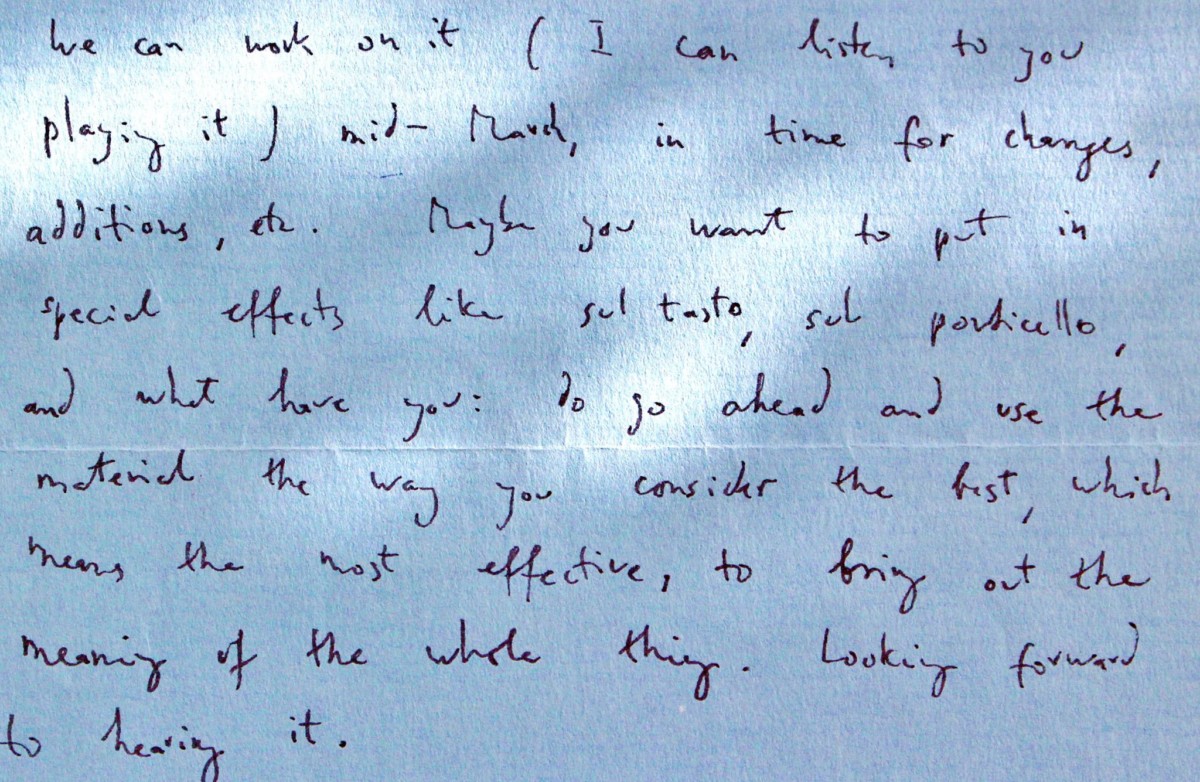
A favourite letter to me from Hans Werner Henze, on my desk.
Letter to a young musician from the USA 24 4 25
What a fascinating letter! I really appreciate that you are thinking deeply about these questions: I apologise if my answer is a little perfunctory, and will endeavour to amplify points later.

Your question about an audience is well taken: I appreciate that my approach is not for everyone, and also that my work is an acquired taste, and that my understanding of the stage is personal! My sense is that the privilege that the stage affords, is to make a shared community of voices, that the music is the community of voices that produce it – composer, performer/s, audience, the space, the score, the history … so what you refer to as the ‘mood’ of the audience is something I am not sure that I have experienced. What I do feel, work with and among, every time the bow goes on the string, is a shared dialogue, a colloquy. Ever note, every gesture, both on the stage, and off it, are part of that, an depend upon it!

Detail: ‘A Sonata of Beethoven’ – Alfred Emslie (1912)
In this context the hierarchies of sonata playing are fascinating – and in the context of Op 30 No 2, to which you refer – loaded, freighted, fraught. The first thing is that, technically, these pieces are NOT duets, but Piano sonatas with violin accompaniment. Which means that playing the piece as a violin concerto manque is simply, well, wrong, on every level.
 Let me get nerdy, precise: I know every note of this piece, every manuscript source, every place where Beethoven changed his mind (he added five bars in the scherzo as an afterthought – pasted in, as a flap). I can write it out – the piano part too, from memory, and yes, that includes the dynamics. And I can show you all the places where Beethoven’s quill pen gives clues as to the phrasing – and I can show you where, working with Schuppanzigh, he adjusted the extremely precise dynamics, obsessively, neurotically. This attention to the affect on both the micro- and macro- level, is the essence of the Beethoven Piano/Violin Sonatas, particularly the Op 30s (alongside the Op 31 Piano Sonatas – which a linked set) and the astonishing op 29 Quintet.
So the question, of what is right to do on stage, is, for me subservient to how do I ensure that everyone involved in the performance  (see para 1!) can be as close to this astonishing work as possible. And that means having a lively relationship to the detail in the score – which can mean choosing to deny it, saying ‘no’ or ‘yes’ to the composer, and to the audience, and to the trajectories of the music.
Because there are so many stories lurking behind these pieces: obviously the troubling dedication has to be one of them – Tzar Aleksandr 1 came to power in 1799 possible as the result of murdering his father Tzar Paul, and began his reign by committing genocide in the Caucasus. The military characteristic of the whole of this sonata explicitly depict his martial ‘qualities’ – the troubled calm of the slow movement is disturbed by gunshots. So there’s another level of music-making, of portraiture, of theatre, to be considered (the choice of C minor plays into this).
So your enquiry about ‘interpretation’ plays into all of this. It’s not something I think about. In my experience, playing music regularly from the 16th-21st centuries, I aim to find a way to get as close to the music as possible, to recognise that there is not aspect of a score which is trivial, nothing which might not offer a clue to its mystery, no stone which I won’t turn over, to get to what the composer might be saying, singing, exploring, and even hiding. There’s no such thing as a ‘spot on’ interpretation, which due respect to Ms Barton Pine (whose marvellous work I admire), because, even knowing music upside down and inside out, having played it for decades, studied every source, knowing the history, the context, the entries in in the Kinsky-alm Verzeichniss, having technical solutions to every inch of the violin part … und so weiter … I know nothing, until I, with my pianist, share the work, till the listener contributes, teaches me. For I have to say, to appropriate John Cage: ‘“I have nothing to say and I am saying it and that is poetry as I need it.” What’s fantastic, is what happens when all the elements are set in motion and it all happens!
Hope that’s a little useful!

Letter to a young string player from Sydney 24 04 25
Do you mind if I give you some things to think about – I think that, bearing in mind your call for empathy with today’s global situation I think that it would help your excellent project to embrace a more complex, pluralistic approach to the period you are referring to.

First of all, I think that it would be a good idea to acknowledge that the notion of the ‘great patriotic adventure’ of WWI was over by 1916. On ever side, at in 1914-15 (Germany, Austro-Hungary, France, Russia. Turkey the British Empire – for such it was then), the conflict was propagandised as an Arthurian conflict, complete with shivering sword clashes, and brazen armour, and the appropriate classical music to encourage and accompany, be it Parry, Tchaikovsky, and of course, Wagner). As most of the conflict, in the UK anyway, was fought within one day’s train/boat trip from London (and the barrages were audible at night from Piccadilly Circus), it was impossible to hide the reality  (even though govt. Censors tried  very hard) from family, friends, and the press. The flood of injured coming into Charing Cross Station (Officers) and Waterloo, where the corpses were also brought, made sure of that – it was in everyone’s faces every day.
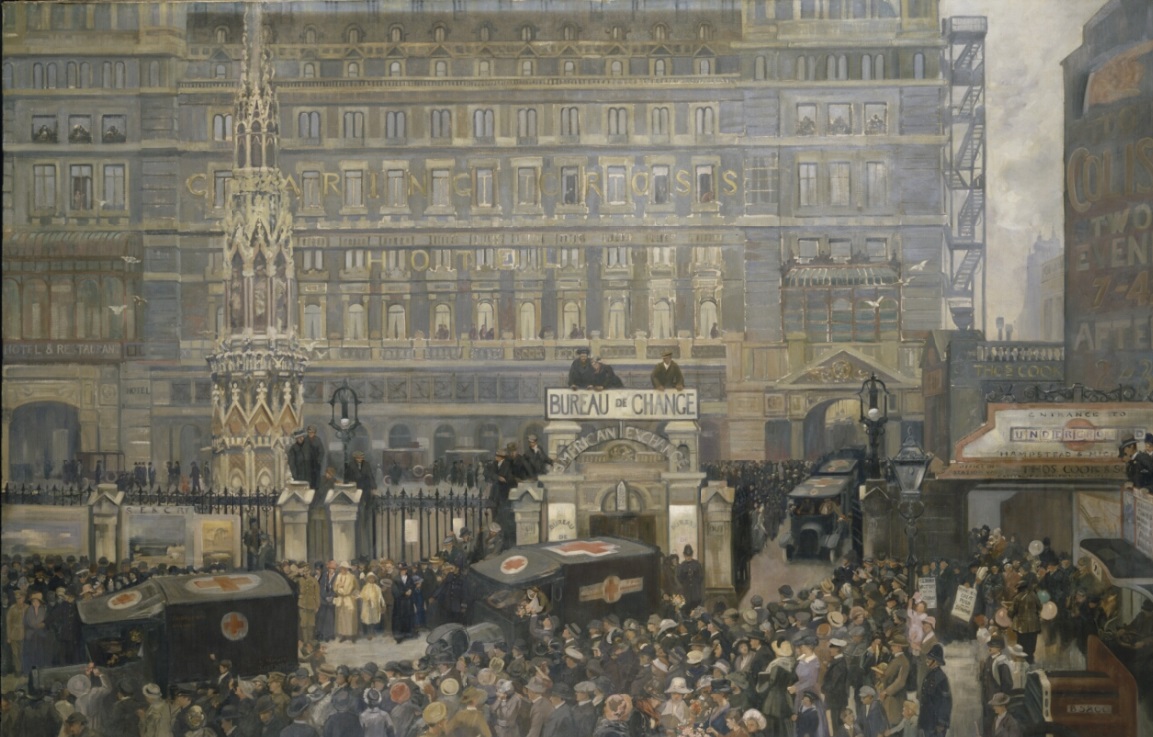
Casualties from the Battle of the Somme (1916)(signed)Hobson Lobley 1919. Imperial War Museum

The linked catastrophes of the Somme and Gallipoli campaigns made sure of that. And of course the hardships mass desertions on the Eastern Front, led to the two revolutions in Russia in 1917. In the case of Germany, this was compounded by the horrific injustice of the Treaty of Versailles and the imposition of the ‘War Guilt Clause’ on the country (driven by French and English election campaigns) and the concomitant £6600 million reparations imposed on a country where the naval blockade continued whilst the industrial heartland  was stolen by the victorious powers – resulting in years of horrific famine and economic collapse (which would result in the Beer Hall Putsch in 1922 …).
In the UK, this was directly linked to the Irish struggle for independence – in  1916 the Republicans launched their armed campaign against the centuries-long English occupation – to a degree assisted by Germany –  which would lead to independence – there is a correlation between events in Russia and in Ireland. Bax’s complex relationship to Irish-ness, informs his music. My point here, is that any notion of the ‘British’ pastoral, is laden with exciting problems : in fact, no resident of these islands uses these words, we refer to the English Country Side, the Scottish Mountains, the Irish Green – then region by region. Remember that at the beginning of the war, the majority of people in every country not only would not have left their countries, but would never leave their county. In fact, the two words were interchangeable -think of the position of the Hobbits at the beginning of the LofRs – that’s an accurate depiction of the attitude to the land which Bax and Bainton are evoking.
And then there’s the Antipodean position, indeed the complexity of anyone living in the shadow of the British Empire. Think of the complex emotions evoked by ANZAC day, the sense that the English were prepared to cast away hundreds of thousands of young men on a disastrous attack on the beaches of the Dardanelles (you may not know that there is still equal anger in Turkey about what their govt. Did on the other side, where the battle was also ruinous). It’s estimated, on top of this, that about 4 million unknown men died worldwide as the result of forced labour to fuel the British war effort (particularly in Africa)… So I would ask you to think about where you fit into these questions? What is your position? How does the music fit into your history: this is the question I have to ask myself, coming from a working class East End background, when I play the music of this period, be it Dale, Boulanger, Hindemith, Ives ….
So tell me your thoughts – and maybe think a little about enriching the materials accompanying your fascinating proposal!
All best
Letter to an American string player 10th August 2025
As an artist, it is inevitable that your work will always being in the context of other people working in your field, just as much as it only ‘does its work’ in dialogue – with the music that you play, with the composers that wrote it, with the era that it was written in, with your own era, with ideas, and of course, with your audience and with your colleagues. But the most important dialogue, the one which is the furnace, the forge, the crucible where your art is made, is with yourself. There is a direct, and vital relationship, between your art, your passion for it, and the conviction that you are are failing. That is a constant for the artist, and the thing that drives us back to the instrument, to the music: as a climber, one of the fuels for my fire, each morning on the bouldering wall, is my fear of falling. 
 
This of course, will not make you feel any better, neither will my conviction that the idea of stepping away from the Art is also a superpower! If I am honest, I learnt to not rank anyone on a scale – I know that I am as likely, for instance to learn from a colleague who might be ‘not as good’ as me, as from a superstar. 
 
My daily dialogue, is simply with what I am doing – now: the present participle, its continuing nature, is the key. 
 
This morning ( we are staying with friends with a little lake in Connecticut), I sent aside 60 minutes for some developmental practice ( between conversations and swimming). The target was a  short sonata by Pietro Castrucci, which I am performing at the end of September. In some ways my practice was very prosaic – my aim was simple. What technical approach did the composer/violinist expect when they wrote it in the early 1700s. So, very simply I worked out their fingerings, bowings,  and what the aesthetic intention, the affect is of music and its execution. So it also functions as a violin lesson, albeit with a dead player. At some point I start to debate the composer: at one point, I did not like the fingering explicit in the (original) edition – my slight gripe is that the composer avoided 2nd position, and the sequences of the music demanded  it in one particularly moment. So there’s a very real moment of argument, across centuries, but all linked to the intention – to realise the music as beautifully as possible. 
 
I find this process, the techne of the instrument, discovering the physiology each era, each composer, each particular piece demands, inspiring and frustrating every day. But at the end of this short exploration, I realise that I have learnt something – this can be small or profound, revelatory or quotidian. But it is my daily bread, and helps me relate to the world around me – a

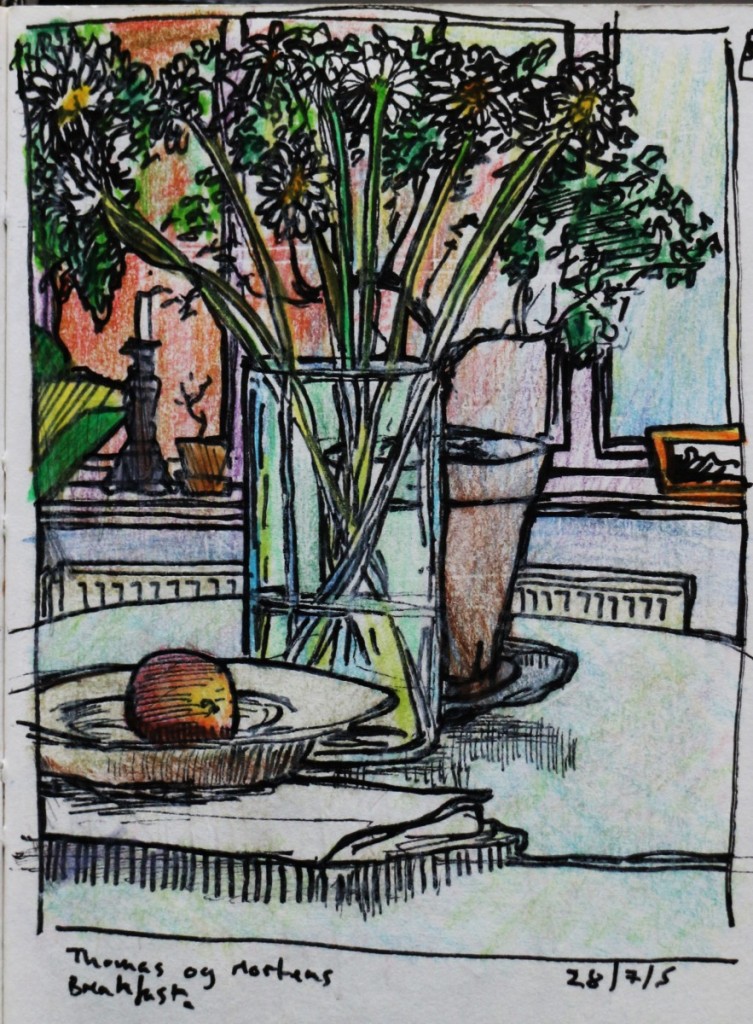
Flowers on Thomas and Morten’s Table. July 2001

vase of wild flowers on the table where I am writing this, or to make a small step towards better engagement with the mores and wonts of the early 1700s. And every time, there is the sense of building from nothing, that my mind, my hands, my imagination, might, can fail. And sometimes I do – I find Bach and Telemann vey natural, and cannot get comfortable with Handel!

 
So, I would counsel you to find a project, which is just yours, and work it in a holistic manner. And, it may well be that  you need to mute the sounds of other players. Or it could simply be to spend a week just exploring resultant tones on the instrument, to get closer to its materiality. 
 
The most important thing, to quote my much-missed friend and collaborator, Hans Werner Henze is: ‘Don’t lose heart.’ There is great work to be done and your sense that it is challenging, your integrity and modest, equip you for the endeavour!
 
With friendship
 
Peter